Emergency Operations Centers
Off-Site Support for Incident Operations
Learning Objectives
- Describe EOC Functions
- Describe EOC Staff Organization Models
- Describe EOC Activation Levels
What is an EOC?
The Support Hub Behind the Scenes
While ICS manages the incident on scene, Emergency Operations Centers provide the off-site coordination and support that makes large-scale response possible.
EOC - Emergency Operations Center
An off-site location where staff from multiple agencies come together to address imminent threats, provide coordinated support to incident command, and coordinate with other EOCs.
ics: ICS manages on-scene, tactical-level response
eoc: EOCs provide off-site coordination and support
Primary Functions
- Collecting, analyzing, and sharing information
- Supporting resource needs and requests
- Coordinating plans and determining current and future needs
- In some cases, providing coordination and policy direction
- Fixed locations (dedicated facilities)
- Temporary facilities (set up as needed)
- Virtual structures (staff participating remotely)
EOC vs Operations Centers
Don't confuse EOCs with single-agency operations centers.
Emergency Operations Centers
- Multidisciplinary - multiple agencies
- Activated for emergencies
- Focus on coordination across organizations
- Support on-scene ICS
Operations Centers
- Single agency or department
- Often 24/7 operations
- Focus on agency-specific functions
- Example: Police dispatch center, utility control room
EOC Organization Models
NIMS identifies three common ways to organize EOC teams. Jurisdictions choose based on their needs, relationships, and capabilities.
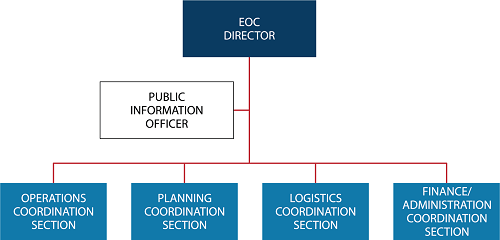
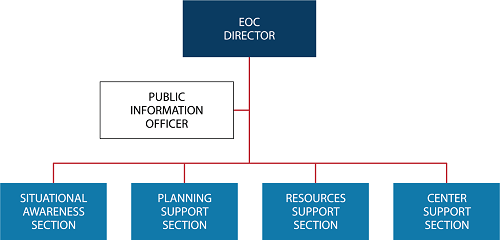
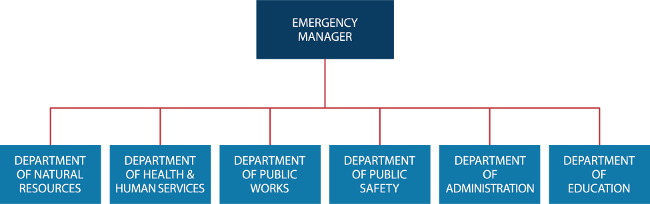
ICS or ICS-like Structure
Organizes the EOC using the standard ICS organizational structure, either exactly as in the field or with modifications.
- Familiar structure for responders
- Aligns directly with on-scene organization
- Easy to interface with ICS in the field
Incident Support Model (ISM)
Separates situational awareness from planning and combines operations/logistics into incident support.
- Emphasizes information and planning functions
- Focuses on supporting the incident rather than directing it
- Good for EOCs that primarily provide support
Departmental Structure
Uses the jurisdiction's day-to-day departmental structure and relationships.
- Familiar relationships for staff
- Minimal preparation or startup time
- Works with existing organizational culture
Compare EOC Organization Models
Explore the three EOC organization models by clicking on each tab. Compare their structures, strengths, and best uses.
ICS/ICS-like
Organizes the EOC using the standard ICS organizational structure, either exactly as in the field or with modifications to better suit the EOC environment.
- EOC Director at top (similar to Incident Commander)
- Operations, Planning, Logistics, Finance/Admin Coordination Sections
- Public Information Officer position
- Mirrors on-scene ICS organization
Strengths
- Familiar structure for responders trained in ICS
- Aligns directly with field operations
- Easy to interface with on-scene ICS
Limitations
- May not fit all jurisdictions' cultures
- Can feel overly structured for smaller EOCs
Incident Support Model
Separates situational awareness from planning and combines operations/logistics into incident support. Focuses the EOC on supporting field operations.
- EOC Director at top
- Situational Awareness Section
- Planning Support Section
- Resources Support Section
- Center Support Section
Strengths
- Emphasizes information and planning functions
- Focuses on supporting rather than directing field operations
- Strong situational awareness capability
Limitations
- Less familiar to responders trained in ICS
- May require additional training
Departmental
Uses the jurisdiction's day-to-day departmental structure. Department representatives coordinate from the EOC using their normal organizational relationships.
- Emergency Manager at top
- Department representatives (Public Works, Health, Police, Fire, etc.)
- Follows normal organizational chart
- Uses existing reporting relationships
Strengths
- Familiar relationships for staff - minimal startup time
- Works with existing organizational culture
- Easy to fill positions with known personnel
Limitations
- May not integrate well with on-scene ICS
- Can create coordination gaps between departments
Knowledge Check
Which EOC structure may reflect an organization that focuses efforts on information, planning, and resource support?
EOC Activation
When Do EOCs Activate?
EOCs activate for various incidents, threats, and events. Not every incident requires EOC activation.
EOC Activation Levels
EOCs frequently have multiple activation levels to scale response appropriately.
Normal Operations / Steady-State
No incident or specific risk identified. Routine watch and warning activities if the EOC normally houses this function.
Staffing: Minimal or normal staffing
Enhanced Steady-State / Partial Activation
Certain EOC team members activated to monitor a credible threat or support response to a new, potentially evolving incident.
Staffing: Key personnel activated, others on standby
Full Activation
EOC team fully activated, including personnel from all assisting agencies, to support response to a major incident or credible threat.
Staffing: All positions filled, 24/7 operations
EOC Activation Scenarios
Read each scenario and determine the appropriate EOC activation level. Think about the scope, complexity, and resource needs of each situation.
Severe Thunderstorm Watch
What EOC activation level is appropriate?
Knowledge Check
Match the following descriptions to their EOC Activation Level.
Knowledge Check
One more check on EOC concepts.
What does a Level 1 EOC activation indicate?
Training Day 5 Complete
Today you learned about Emergency Operations Centers - the off-site coordination hubs that support on-scene ICS operations.
Key Takeaways
EOC Functions
Information collection/analysis, resource support, coordination, and in some cases policy direction.
Three Organization Models
ICS-like (mirrors field structure), Incident Support Model (focuses on information/planning/resources), and Departmental (uses existing structure).
Three Activation Levels
Level 3 (Normal), Level 2 (Partial/Enhanced), Level 1 (Full Activation).
EOC vs ICS
ICS manages on-scene tactical operations. EOCs provide off-site coordination and support.