Other NIMS Structures & Interconnectivity
MAC Groups, JIS, and How It All Connects
Learning Objectives
- Identify the roles and responsibilities of the Multiagency Coordination Group (MAC Group)
- Describe the Joint Information System (JIS)
- Describe the interconnectivity of NIMS Command and Coordination structures
The Complete Picture
Four Structures, One System
You've learned about ICS and EOCs. Now let's complete the picture with MAC Groups and the Joint Information System, then see how all four structures work together.
ICS
On-scene management of incidents
EOC
Off-site support for on-scene operations
MAC Groups
Policy guidance and scarce resource allocation (NEW)
JIS
Coordinated public information across all structures (NEW)
Multiagency Coordination Groups (MAC Groups)
Policy-Level Coordination
MAC Group - Multiagency Coordination Group
A group of administrators, executives, or their designees who provide policy guidance and prioritize resources during incidents.
Real World Example
During a major wildfire, the MAC Group might include the county administrator, fire chief, sheriff, public health director, and representatives from utilities and the Red Cross. They make policy decisions about evacuations, resource priorities, and public messaging direction.
Elected and Appointed Officials
Leadership at the Policy Level
Elected and appointed officials (governors, mayors, city managers, county commissioners) are key players in incident management.
Our elected and senior appointed officials have first a moral obligation to do whatever is possible to provide for the well-being, the welfare if you will, of the citizens that elected them and entrusted them with their well-being.
— Steve Grainer, Former Chief, Incident Management Programs, VA Dept. of Fire Programs
Voices of Experience: Elected Officials
1:28Knowledge Check
Which of the following statements are correct about MAC Groups? Select all that apply.
Joint Information System (JIS)
One Voice for Public Information
JIS - Joint Information System
A system that integrates incident information and public affairs into a unified organization that provides consistent, coordinated, accurate, accessible, timely, and complete information to the public and stakeholders.
PIO and JIC
Two key elements support the JIS:
Public Information Officer (PIO)
A key member of ICS and EOC organizations responsible for public information.
Key Functions
- Advising the IC, Unified Command, or EOC director on public information
- Gathering, verifying, coordinating, and disseminating accurate information
- Handling inquiries from media, public, and elected officials
- Providing emergency public information and warnings
- Conducting rumor monitoring and response
Joint Information Center (JIC)
A central location that houses JIS operations and where public information staff perform their functions.
- Normally, an incident should have a single JIC
- Multiple JICs can be established if necessary
- Brings together PIOs from all involved agencies
The JIS Information Cycle
- Gathering complete information
- Verifying information for accuracy
- Coordinating with other public information personnel
- Disseminating consistent, accurate, timely information
Explore the JIS Information Cycle
Click on each step in the cycle to learn what happens at that stage and why it matters for effective public information.
Click on each step to explore the JIS Information Cycle.
Voices of Experience: Public Information
2:26Knowledge Check
Which of the following are supporting elements of the JIS? Select all that apply.
NIMS Interconnectivity
How It All Works Together
NIMS structures don't operate in isolation. They're interconnected, with information and coordination flowing between them.
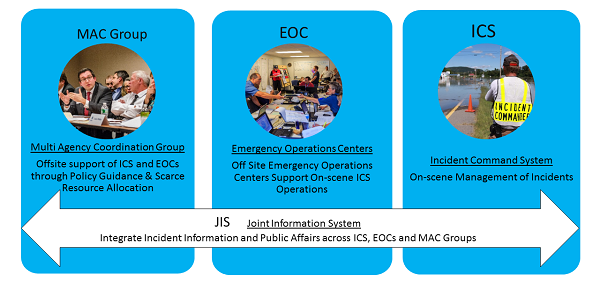
When an incident occurs or threatens:
- Local emergency personnel manage response using NIMS principles and ICS
- If large or complex, local EOCs activate to support on-scene operations
- EOCs receive senior-level guidance from MAC Groups
- A JIC manages JIS operations for coordinated public messaging across all levels
- If resources aren't available locally, mutual aid provides resources from other jurisdictions, states, or federal sources
ICS ↔ EOC
EOC supports ICS with resources, coordination, information
MAC Group ↔ EOC
MAC Group provides policy guidance to EOC
MAC Group ↔ ICS
MAC Group provides policy guidance on resource priorities
JIS ↔ All
JIS coordinates public information across ICS, EOC, and MAC Group
Explore NIMS Command & Coordination Structures
Click on each structure to learn how it connects to the others. Explore all four nodes to understand how NIMS coordinates incident management at every level.
Click on any structure below to explore its role and connections.
Federal Support
When Does the Federal Government Get Involved?
Federal Involvement
Triggers:
- State governors or tribal leaders request federal assistance (and it's approved)
- Federal interests are involved
- Statute or regulation authorizes or requires it
Typical Role: Supporting role - providing assistance to affected state, tribe, or territory
Federal Takes the Lead When:
- Incidents on federal property
- Federal primary jurisdiction (terrorist attack, major oil spill)
Provides federal assistance when the President declares an emergency or major disaster
Knowledge Check
When an incident occurs, local emergency personnel manage response using which of the following?
Training Day 6 Complete
Today you completed your understanding of NIMS Command and Coordination structures and learned how they all work together.
Key Takeaways
MAC Groups
Policy-level bodies that provide guidance, prioritize resources, and enable cooperative multi-agency decisions.
Joint Information System (JIS)
Ensures consistent, coordinated public information across all NIMS structures through PIOs and JICs.
Interconnectivity
ICS on scene → EOC supports → MAC Group provides policy → JIS coordinates public messaging across all.
Federal Role
Usually supporting state/local efforts; only leading when federal interests or jurisdiction are involved.
The Four NIMS Command and Coordination Structures:
- ICS: On-scene incident management
- EOC: Off-site coordination and support
- MAC Groups: Policy guidance and resource prioritization
- JIS: Coordinated public information