Incident Command System (ICS)
The Structure of On-Scene Command
Learning Objectives
- Describe the Incident Command System (ICS) Organizational Structure
Introduction to ICS
The Framework for Every Incident
The Incident Command System is the standardized approach to on-scene emergency management. It's used every day, on every incident, across the entire country.
ICS - Incident Command System
A standardized approach to the command, control, and coordination of on-scene incident management that provides a common hierarchy within which personnel from multiple organizations can work together.
ICS is a system to allow responders to be able to organize and respond to an incident. It's a format, a system of tools that allow police, fire, and other personnel to respond to that incident in a systematic way.
— George Nuñez, Emergency Management, George Washington University
Voices of Experience: Incident Command System
2:07NIMS Command and Coordination Overview
Before diving deep into ICS, let's see how it fits into the bigger picture of NIMS structures.
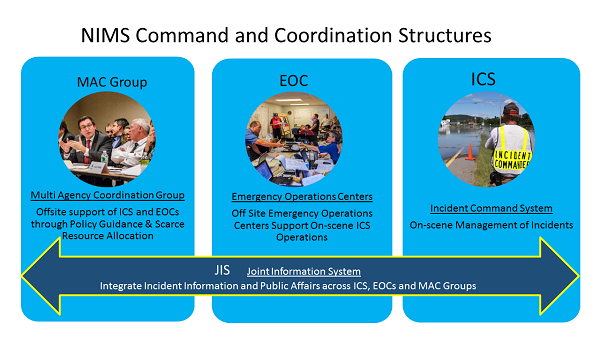
ICS - Incident Command System
On-scene management of incidents
Level: Tactical/Operational
EOC - Emergency Operations Centers
Off-site support of on-scene operations
Level: Coordination
MAC Groups
Policy guidance and scarce resource allocation
Level: Policy
JIS - Joint Information System
Coordinated public information
Level: Spans all levels
Incident Command
Who's In Charge?
The term 'Incident Command' refers to the person or group responsible for overall on-scene management. There are two forms:
Single Incident Commander
One person with overall incident management responsibility
- Establishing incident objectives
- Ensuring that incident activities work to accomplish objectives
Unified Command
Multiple agencies jointly manage through common objectives and a single Incident Action Plan
ICS Organization
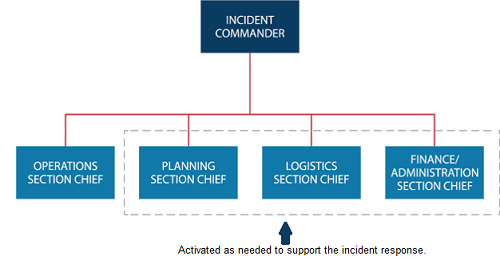
ICS is organized into Command Staff and General Staff. The Incident Commander is supported by both.
Public Information Officer (PIO)
Interfaces with the public and media; handles all incident information
Safety Officer
Monitors incident operations and advises on health and safety matters
Liaison Officer
Point of contact for organizations not included in Unified Command
Operations Section Chief
Manages tactical operations to achieve incident objectives
Focus: Doing the work - suppression, rescue, treatment, etc.
Planning Section Chief
Collects, evaluates, and disseminates information; maintains resource status; develops the IAP
Focus: Thinking ahead - what's happening, what will happen, what's the plan
Logistics Section Chief
Provides resources, facilities, services, and materials to support the incident
Focus: Getting what's needed - supplies, equipment, food, communications
Finance/Administration Section Chief
Monitors costs, processes contracts, tracks personnel time, handles claims
Focus: Managing money - costs, contracts, compensation, claims
Build the ICS Organization
Watch how the ICS organization grows as an incident escalates. At each stage, answer the question about what positions should be activated.
Small Incident: Single-Vehicle Accident
At this point, who handles all ICS functions?
Command Staff Details
Let's look closer at the three Command Staff positions. These report directly to the Incident Commander.
Public Information Officer (PIO)
In a crisis, people need information. The PIO ensures accurate, timely information reaches the public while preventing rumors and misinformation.
- Interface with the public and media
- Gather and release incident information
- Monitor news coverage for accuracy
- Coordinate with JIS for multi-agency incidents
- Arrange interviews and press conferences
Safety Officer
The Safety Officer has authority to immediately stop any operation they deem unsafe. Responder safety is paramount.
- Identify and mitigate hazardous situations
- Review the Incident Action Plan for safety implications
- Monitor operations for safety concerns
- Advise the IC on safety matters
- Authority to stop unsafe operations
Liaison Officer
When multiple agencies respond but aren't part of Unified Command, they need a single point of contact. The Liaison Officer serves that role.
- Be the point of contact for assisting and cooperating agencies
- Maintain list of cooperating agencies and their representatives
- Assist in setting up agency communications
- Monitor incident operations to identify problems
- Coordinate with agency representatives
General Staff Details
The four General Staff sections handle the major functional areas of incident management.
Knowledge Check
Which of the following is associated with multi-jurisdictional or multi-agency incident management?
Intelligence/Investigations Function
The I/I Function
Intelligence/Investigations (I/I) is an ICS function identified in NIMS that can be placed in different locations depending on the incident.
Placement Options
- Within the Planning Section
- Within the Operations Section
- As part of the Command Staff
- As a separate General Staff section
- Combination of these locations
Factors:
- Nature of the incident
- Level of I/I activity required
- Relationship of I/I to other incident activities
Examples
- For a wildfire: I/I might be minimal, placed in Planning
- For a terrorist attack: I/I would be significant, possibly its own section
- For a hazmat incident with criminal aspects: I/I might be split between Operations (field investigators) and Planning (analysis)
ICS Facilities
The Incident Commander determines what facilities are needed based on incident requirements.
Incident Command Post (ICP)
The location where the Incident Commander and Command/General Staff operate
Staging Area
Where resources wait until they're assigned
Incident Base
Location for primary support activities
Camps
Satellite locations providing food, sleeping areas, sanitation, and minor equipment servicing
Incident Management Teams
Pre-Formed Teams Ready to Deploy
Incident Management Teams (IMT) are rostered groups of ICS-qualified personnel ready to deploy and manage incidents.
- Composed of an Incident Commander, leadership, and personnel qualified for key ICS positions
- Established at local, regional, state, tribal, and national levels
- Typed based on team member qualifications
- Have formal notification, deployment, and operational procedures
Incident Management Assistance Teams (IMAT)
Some IMTs are called IMATs to clarify that they support on-scene personnel and/or affected jurisdictions
Area Command
Managing Multiple Incidents
An Area Command oversees the management of multiple incidents or a very complex incident that has multiple ICS organizations.
When Used
- Multiple incidents in the same area competing for resources
- A very large or complex incident requiring multiple ICPs
- Situations where span-of-control considerations require an additional layer
Knowledge Check
Which of the following statements are accurate about Area Command? Select all that apply.
Knowledge Check
One more check on ICS concepts.
When is Unified Command used instead of a single Incident Commander?
Training Day 4 Complete
Today you learned the Incident Command System - the organizational structure used on every incident scene in America.
Key Takeaways
ICS Organization
Command (IC or Unified Command), Command Staff (PIO, Safety, Liaison), and General Staff (Operations, Planning, Logistics, Finance/Admin).
Single vs Unified Command
Single IC for single jurisdiction; Unified Command for multi-agency incidents with shared objectives and one IAP.
Modular and Scalable
Only activate positions needed. A small incident might only need an IC; a large disaster activates the full structure.
Facilities
ICP, Staging Areas, Base, and Camps support incident operations.
IMTs and Area Command
Pre-formed teams deploy to manage incidents; Area Command coordinates multiple incidents.