Management Characteristics
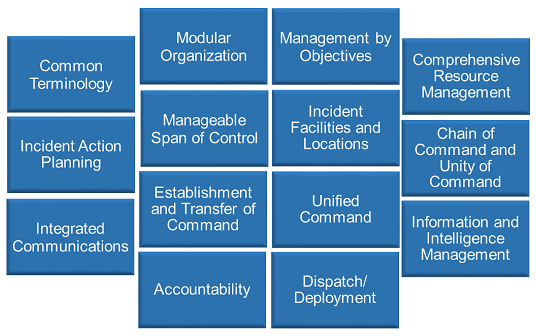
The 14 Building Blocks of Incident Management
Learning Objectives
- Differentiate among the fourteen NIMS Management Characteristics
The Foundation of Effective Incident Management
14 Characteristics That Make It Work
NIMS isn't just theory - it's built on specific, proven management characteristics that have been refined through decades of real-world experience.
Common Terminology
Using standard, consistent terminology enables effective communication across all organizations involved in an incident.
When a California firefighter talks to a New York police officer during a disaster, they need to speak the same language. 'Staging Area' means the same thing everywhere. 'Incident Commander' has the same meaning in every state.
Key Components
- Standard names for organizational functions and positions
- Standard names for resources
- Standard names for facilities
- Plain language (no codes or jargon that others might not understand)
Real World Example
During multi-agency responses, agencies often use different meanings for radio codes like '10-4' or '10-20'. NIMS requires plain language - say 'acknowledged' or 'what's your location' instead.
Modular Organization
The incident organization is built from the top down, adding only the positions and resources needed for the specific incident.
A car accident doesn't need the same organization as a hurricane. Modular organization means you build what you need, when you need it - and nothing more.
Key Principles
- Start with command (Incident Commander)
- Add positions only as needed based on incident size and complexity
- Each element added must have a clear function and reporting relationship
- Structure can expand or contract as the incident evolves
Real World Example
A small structure fire might only need an Incident Commander. As the fire spreads, Operations, Planning, and Logistics sections activate. When mutual aid arrives, the organization expands further. As the fire is contained, the organization contracts back down.
Management by Objectives
A systematic process for managing incidents that includes establishing specific, measurable objectives and strategies.
Everyone needs to know what they're trying to accomplish. Clear objectives ensure that all personnel are working toward the same goals.
Process Steps
- Step 1: Understand agency/jurisdiction policies and direction
- Step 2: Assess incident situation
- Step 3: Establish incident objectives
- Step 4: Select appropriate strategies
- Step 5: Assign tactical actions
- Step 6: Document results
Example
'Contain fire to the structures of origin within 2 hours' is specific, measurable, and time-bound. 'Put out the fire' is not.
Incident Action Planning
The process of developing and documenting the incident objectives, strategies, and tactics to achieve those objectives.
An Incident Action Plan (IAP) ensures everyone knows the objectives, knows their assignments, and knows the plan for the operational period.
Key Elements
- What we want to achieve (objectives)
- How we're going to do it (strategies and tactics)
- Who's responsible for what (organization and assignments)
- How we'll communicate (communications plan)
- Safety considerations (medical plan, safety messages)
Manageable Span of Control
The number of subordinates one supervisor can effectively manage, typically ranging from 3 to 7, with 5 being optimal.
If one person tries to supervise too many people, things get missed. If they supervise too few, resources are wasted. The 3-7 range is proven effective.
Optimal: 5 subordinates per supervisor
Range: 3 to 7 subordinates
Factors affecting span of control:
- Type of incident
- Nature of the task
- Safety considerations
- Communication capabilities
- Distance between elements
Real World Example
A Division Supervisor shouldn't directly oversee 20 firefighters. Instead, those 20 are organized into 4 groups of 5, each with a Group Supervisor who reports to the Division Supervisor.
Span of Control Calculator
Use the slider to explore how span of control affects organizational effectiveness. See what happens when a supervisor has too few or too many direct reports.
Guideline: NIMS recommends 3-7 subordinates per supervisor, with 5 as the optimal ratio.
Incident Facilities and Locations
Specific locations established to support incident operations, each with standard names and functions.
When someone says 'report to Staging,' everyone knows what that means and what happens there.
Incident Command Post (ICP)
Location of tactical-level, on-scene incident management. This is where the Incident Commander operates.
Staging Area
Location where resources (personnel, equipment) wait until they're assigned. They're ready to go but not yet deployed.
Incident Base
Location for primary support activities. May be co-located with the ICP.
Camps
Satellite locations for food, sleeping, sanitation, and minor equipment servicing.
Sort the 14 Management Characteristics
Sort all 14 NIMS Management Characteristics into their correct categories. Drag each characteristic card to the appropriate group.
Tap a characteristic to select it, then tap the category where it belongs.
Interactive card sort with 14 NIMS Management Characteristics to categorize into 5 groups. Use Tab to navigate items, Enter to select, then navigate to the target category and press Enter.
Organization & Management
How incidents are structured and managed
Facilities & Resources
Physical locations and resource coordination
Communication & Information
Information flow and communications systems
Command Structure
Authority, leadership, and chain of command
Operations
Personnel tracking and resource deployment
Knowledge Check
Which NIMS Management Characteristic allows units from diverse agencies to connect, share information, and achieve situational awareness?
Comprehensive Resource Management
Maintaining accurate, up-to-date inventories and tracking resources throughout the incident lifecycle.
You covered this in Training Day 2, but it's important enough to be one of the 14 characteristics. Managing resources effectively is fundamental to incident management.
Integrated Communications
Communications systems that enable personnel from multiple agencies to connect, share information, and maintain situational awareness.
If agencies can't talk to each other, they can't coordinate. Integrated communications ensures everyone can connect.
Requirements
- Common communications plans
- Interoperable communications systems
- Common terminology (no agency-specific codes)
- Clear text/plain language
- Shared information systems
Real World Example
During 9/11, fire and police couldn't communicate directly because their radios used different frequencies. This contributed to the loss of life. Integrated communications prevents this.
Establishment and Transfer of Command
The incident command function must be clearly established from the beginning of an incident, and the process for transferring command must be clear and documented.
Without clear command, no one knows who's in charge. Without clear transfer procedures, critical information gets lost during handoffs.
Key Points
- The first arriving qualified person establishes command
- Command transfers to more qualified personnel as they arrive
- Every transfer requires a complete briefing on incident status, objectives, and current plan
- Document all command transfers
Real World Example
A patrol officer arrives first and takes command. When the Fire Captain arrives, command transfers with a briefing: 'We have a two-car collision, three patients, one critical. EMS is en route, traffic is blocked northbound.' Clear handoff, no information lost.
Unified Command
When an incident involves multiple jurisdictions or agencies with authority, Unified Command enables them to jointly manage and direct incident activities.
Many incidents cross boundaries - geographic, functional, or political. Unified Command prevents agencies from working at cross purposes.
Key Points
- Partners jointly determine objectives
- Each agency maintains authority over its own resources
- One incident, one set of objectives, one Incident Action Plan
- Eliminates conflicts between agencies
Real World Example
A hazmat spill on an interstate involves fire (hazmat response), state police (traffic/investigation), EPA (environmental oversight), and the responsible party (cleanup). All four participate in Unified Command, speaking with one voice.
Chain of Command and Unity of Command
Chain of command is the orderly line of authority. Unity of command means each person reports to only one supervisor.
Conflicting orders from multiple supervisors create confusion and danger. Clear command lines keep everyone aligned.
Key Points
- Chain of Command: clear reporting relationships up and down the organization
- Unity of Command: every person reports to exactly ONE supervisor
- Avoids conflicting instructions and confusion
- Does not prevent direct communication for coordination - just clarifies who gives orders
Real World Example
A firefighter can radio directly to another crew for coordination. But orders come only from their assigned supervisor. If someone else tries to reassign them, the firefighter checks with their supervisor first.
Accountability
Effective accountability ensures that personnel are accounted for and that supervisors can track their locations and welfare.
If a building collapses, command needs to know immediately who was inside. Accountability saves lives.
Principles
- Check-in: All responders must check in upon arrival
- Incident Action Plan: Defines objectives and assignments
- Unity of Command: Everyone has one supervisor who knows their location
- Span of Control: Supervisors can effectively track their personnel
- Resource Tracking: Systems track all personnel and resources
Dispatch/Deployment
Resources should only respond when requested or dispatched through established authorities.
Self-deployment creates chaos. When resources show up without being requested, it complicates tracking, depletes resources elsewhere, and can interfere with planned operations.
Key Principles
- Resources respond only when requested or dispatched
- Self-deployment is prohibited
- Requested resources must be managed throughout the incident
- Resources must check in upon arrival
Information and Intelligence Management
The process for gathering, analyzing, and sharing incident-related information, including intelligence information when applicable.
Good decisions require good information. This characteristic ensures information flows to those who need it.
Applications
- Situational awareness for all personnel
- Analysis to support planning
- Intelligence for law enforcement incidents
- Public information for JIS
- Information security for sensitive data
Knowledge Check
One more check on the management characteristics.
What is the recommended span of control ratio for supervisors to subordinates under NIMS?
Training Day 3 Complete
Today you learned the 14 NIMS Management Characteristics - the proven building blocks that make incident management work.
Key Takeaways
These aren't optional
Every characteristic contributes to effective incident management. Skip one, and the system weakens.
They work together
Accountability requires Span of Control. Planning requires Objectives. Communications requires Terminology. They're all connected.
Proven through experience
These characteristics evolved from decades of lessons learned in real incidents.