Resource Management
Getting the Right Resources to the Right Place
Learning Objectives
- Describe the four key activities of NIMS Resource Management Preparedness
- Identify the methods for managing resources during an incident
- Describe features of mutual aid
Why Resource Management Matters
Life or Death Logistics
During an incident, getting the right resources to the right place at the right time can literally be the difference between life and death.
Scenario
Imagine a major building collapse with people trapped inside. You need:
- Heavy rescue equipment
- Search dogs
- Medical teams
- Structural engineers
- Heavy equipment operators
Problem: Now imagine these resources are scattered across different agencies, counties, even states. How do you know what's available? How do you request it? How do you track it when it arrives?
Solution: NIMS Resource Management provides the answer - a standardized system for managing resources before, during, and after incidents.
Resource Management Preparedness
Before any incident occurs, organizations must prepare. Resource management preparedness involves four key activities:
Identifying and Typing Resources
Defining and categorizing resources by capability so everyone knows exactly what they're getting.
When you order a 'Type 1 Heavy Rescue Squad,' you know exactly what equipment they bring and what they can do - whether they come from your county or from across the country.
capability
What the resource can do (prevention, protection, mitigation, response, recovery)
category
The function it serves (firefighting, law enforcement, medical)
kind
Broad type (personnel, equipment, teams, facilities)
type
Level of capability (Type 1 has greater capacity than Type 2, 3, or 4)
Qualifying, Certifying, and Credentialing Personnel
Ensuring personnel deploying under mutual aid can actually perform their assigned roles.
When someone shows up claiming to be an Incident Commander, how do you know they're qualified? Credentialing provides that assurance.
qualifying
Meeting minimum standards (training, experience, physical/medical fitness) for specific positions
certifying
Recognition from an Authority Having Jurisdiction that someone has completed qualification
credentialing
Documentation (usually an ID card) that verifies qualifications for a particular position
Planning for Resources
Coordinated planning that identifies resource requirements to meet anticipated threats.
You can't wait until the incident to figure out what you need. Planning identifies gaps and develops strategies to fill them.
- Stockpiling resources
- Establishing mutual aid agreements
- Determining how to reassign resources from non-essential tasks
- Developing contracts to acquire resources from vendors
Acquiring, Storing, and Inventorying Resources
Maintaining current, accurate resource inventories to track status and availability.
You can't send what you don't have. Accurate inventories ensure you know what's available when the call comes.
- Enable organizations to respond promptly when needed
- Support day-to-day resource management
- Identify gaps before they become problems
Voices of Experience: Resource Management
2:10Knowledge Check
Which resource management key activity defines and categorizes incident resources by capability?
Resource Management During an Incident
When an incident occurs, resource management follows a six-step cycle. This process repeats continuously as the incident evolves.
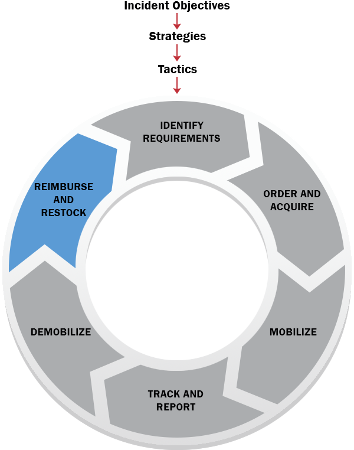
Identify Requirements
Determine what resources are needed, including type, quantity, location, and who will use them.
Key Actions:
- Identify type and quantity of resources needed
- Determine where resources should be sent
- Identify who will receive and use the resources
Order and Acquire
Request resources through appropriate channels.
Key Actions:
- Check if resources are available locally
- Execute contracts or mutual aid agreements if needed
- Request assistance from higher levels of government if necessary
Mobilize
Get resources moving toward the incident.
Key Actions:
- Notify personnel through established channels
- Provide deployment information (departure time, transportation, reporting location, anticipated assignment)
- Begin resource tracking
Track and Report
Monitor resources from mobilization through demobilization.
Key Actions:
- Track location of all resources
- Prepare staff to receive and use resources
- Protect safety and security of personnel and equipment
- Enable resource coordination and movement
Demobilize
Release resources when no longer needed.
Key Actions:
- Plan for demobilization (starts same time as mobilization planning)
- Reassign or release resources as soon as they're no longer needed
- Plan for rehabilitation, replenishment, and return to operational status
Reimburse and Restock
Pay for resources used and restore them to readiness.
Key Actions:
- Collect and validate cost information
- Ensure resource providers are paid timely
- Replace or repair damaged equipment
- Restore resource readiness
Resource Management Process Sequencing
The resource management process follows a six-step cycle. Drag the steps into the correct order, starting from the first step.
Tap and hold a step to drag it into the correct position, or use the arrows to reorder.
Knowledge Check
Which of the following take place within the Track and Report stage of the resource management process? Select all that apply.
Voices of Experience: Mutual Aid
Experienced professionals share their perspectives on mutual aid agreements and how they work in practice.
"Traditionally we've always considered mutual aid between fire departments, EMS agencies, or law enforcement agencies. In today's world it is expanded to virtually every emergency function identified in either the national, State, or local response plan. It includes communications assets, public health assets. Some cases may include military affairs, may include animal refuge, may include search and rescue assets, and a host of others."
"At its simplest level, mutual aid is neighbor helping neighbor. It is adjoining fire departments sharing resources to suppress a fire that's bigger than one agency can handle. It's adjoining water companies helping each other replace a broken pipeline in an emergency because they don't have sufficient manpower or equipment to do it. It's anytime that neighboring agencies leave their jurisdictions to help each other."
"NIMS has proposed a number of solutions that could be applied very readily to mutual aid. One of the problems with mutual aid in the past has been a common terminology, a common nomenclature, speaking the same language. One term to one particular level of government doesn't necessarily mean the same thing to another, and NIMS addresses those particular types of issues. We all try to speak in a common language, plain English. The other real benefit that NIMS can bring is resource typing. We all know that when you need something that is not readily available within your jurisdiction, you need it fast. It speeds up the process when a person that has an asset can understand very quickly what you are asking for, and if those resources are typed, the benefit is that a person requesting something knows what they are going to get when they follow a typing scheme."
Mutual Aid
Neighbors Helping Neighbors
Mutual aid is the sharing of resources and services between jurisdictions or organizations.
Mutual aid happens at all levels:
- Between neighboring communities
- Among all jurisdictions within a state
- Between states, territories, and tribal governments
- Between federal agencies
- Internationally
- Between government and NGOs/private sector
Emergency Management Assistance Compact (EMAC)
A congressionally ratified mutual aid compact that enables state-to-state sharing of resources during emergencies.
Participants: All 50 states, District of Columbia, Puerto Rico, Guam, and U.S. Virgin Islands
Importance: EMAC enables movement of a wide variety of resources to meet the needs of impacted jurisdictions without federal involvement.
When mutual aid is requested:
Supporting jurisdiction evaluates the request against its own capacity
Supporting jurisdiction determines if it can meet its own needs during temporary resource loss
If able, supporting jurisdiction identifies and arranges deployment per the agreement
Receiving jurisdiction can decline resources if they don't meet needs
Knowledge Check
The role of the receiving jurisdiction for mutual aid includes which of the following?
Training Day 2 Complete
Today you learned how NIMS manages resources - the critical function that gets help where it's needed, when it's needed.
Key Takeaways
Four Preparedness Activities
Identifying/Typing resources, Qualifying/Credentialing personnel, Planning for resources, and Acquiring/Inventorying resources.
Six-Step Incident Process
Identify Requirements → Order/Acquire → Mobilize → Track/Report → Demobilize → Reimburse/Restock.
Resource Typing
Categorizing resources by capability, category, kind, and type ensures everyone knows exactly what they're getting.
Mutual Aid
Agreements that enable jurisdictions to share resources, including EMAC for state-to-state assistance.